


Erectile dysfunction (ED) is something most Malaysian men will encounter at some point, whether briefly in their 30s or persistently later in life — yet it remains one of the least discussed health topics in the country. Research suggests that roughly seven in ten Malaysian men between 40 and 70 experience some degree of ED, and almost half of men in their 40s are affected. Despite how common it is, most men never bring it up with a doctor.
That silence has a cost. ED is rarely just about sex. It’s frequently an early signal of cardiovascular disease, diabetes, or hormonal imbalance — conditions that are far easier to manage when caught early. This guide walks through what ED actually is, why it happens, how it shows up before it becomes obvious, and what your options look like, so you can make sense of the condition before deciding on next steps.
What Is Erectile Dysfunction?
At its core, an erection is a blood flow event. When a man is sexually aroused, the muscles in the penis relax, blood flow into the penile arteries increases, and two internal chambers fill and expand — that’s what creates rigidity. When the muscles contract again and blood drains through the penile veins, the erection ends. Erectile dysfunction occurs when something in that chain breaks down: the signal doesn’t fire properly, blood doesn’t flow in fast enough, or it doesn’t stay trapped long enough to sustain rigidity.
Occasional difficulty is normal — a stressful week, a few drinks, exhaustion. ED becomes a medical concern when the pattern is consistent or progressive, and especially when it starts affecting confidence, relationships, or quality of life. It’s also worth noting that “erectile dysfunction” and the older term “impotence” describe the same condition; ED is simply the term used in modern clinical practice.
The Early Signs Most Men Miss

ED rarely arrives overnight. For most men, it builds gradually, and the early signals are easy to explain away. You might notice:
- Needing more stimulation than before to get aroused
- An erection that comes more slowly, or doesn’t feel quite as firm
- Difficulty maintaining an erection through to the end of intercourse
- Fewer or weaker morning erections than you remember having
- A subtle dip in interest in sex, even when nothing else in life has changed
Individually, none of these are alarming. Together, and over time, they’re often the first sign that something physiological is shifting — sometimes years before a man would describe himself as having “ED.” Paying attention to this pattern, rather than dismissing it as a bad week, is usually what separates an easy fix from a complicated one.
Why ED Happens: The Main Causes
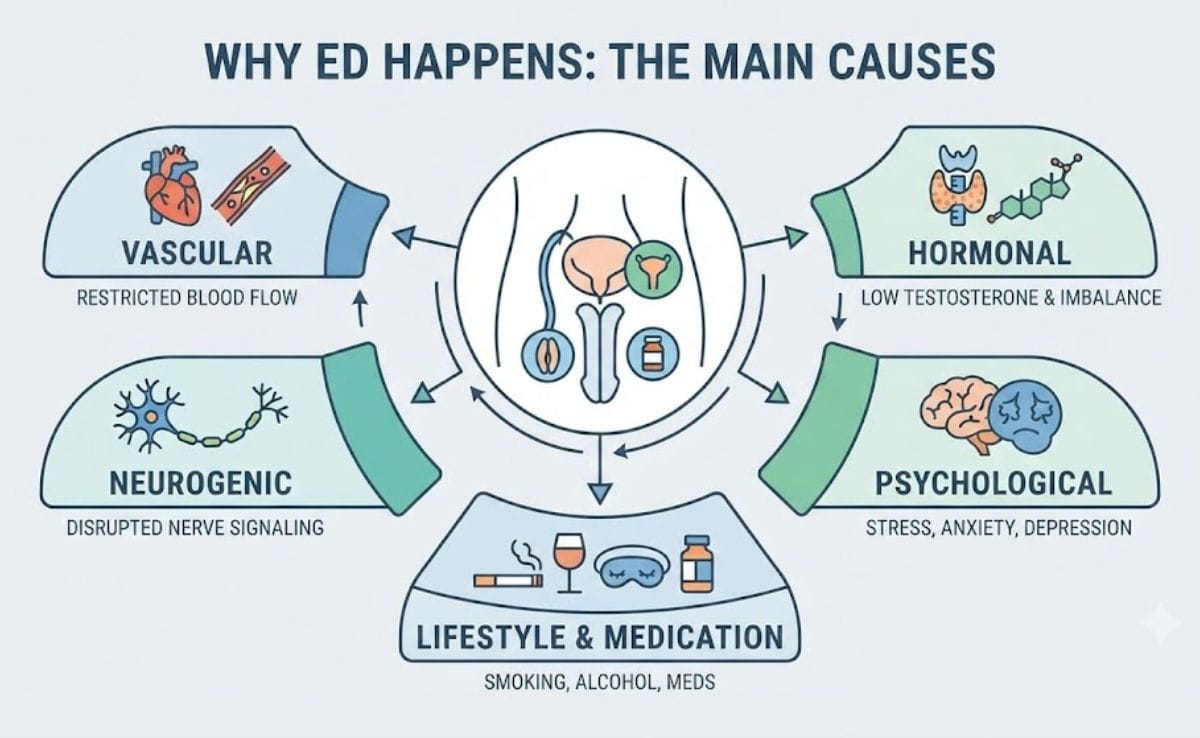
ED is almost never caused by just one thing. Doctors generally group the causes into a few broad categories:
Vascular causes are the most common physical driver — anything that restricts blood flow to the penis, including atherosclerosis, high blood pressure, and high cholesterol, can directly impair erections.
Hormonal causes include low testosterone, thyroid dysfunction, and elevated prolactin, all of which affect libido and erectile function independently of blood flow.
Neurogenic causes involve disrupted nerve signalling between the brain and the penis, which can result from diabetes, spinal injury, or certain neurological conditions.
Psychological causes — performance anxiety, depression, chronic stress, and relationship strain — are especially common in men under 40, and frequently coexist with a physical cause rather than replacing it.
Lifestyle and medication factors round out the picture: smoking, heavy alcohol use, poor sleep, sedentary habits, and certain medications (antihypertensives, antidepressants, and some prostate medications) can all contribute.
In practice, most cases of ED are “mixed” — a combination of two or more of the above. A man with mild vascular narrowing who is also under significant work stress, for instance, is dealing with two compounding factors, not one.
Why ED Is Especially Common in Malaysia

Malaysia’s health landscape creates conditions that make ED more likely, and at a younger age, than in many other countries. A few factors stand out:
Malaysia has some of the highest rates of diabetes and hypertension in Southeast Asia, and both conditions damage the blood vessels and nerves that erections depend on. Traditional Malaysian cuisine, while excellent, tends to be high in sodium, saturated fat, and refined carbohydrates — a dietary pattern that works against cardiovascular health over years of regular consumption. Long office hours and screen-heavy, sedentary routines reduce both circulation and testosterone production. Smoking remains common among Malaysian men and is one of the strongest reversible risk factors for ED — meaning quitting can produce measurable improvement. And cultural stigma around sexual health means many men wait years before raising the issue with a doctor, by which point the underlying condition has often progressed.
None of this means ED is inevitable for Malaysian men — it means the usual causes tend to show up earlier and more often here, which is exactly why early conversations with a doctor matter more, not less.
How Doctors Diagnose ED

A proper diagnosis looks beyond the symptom itself to find the underlying cause, because the right treatment depends entirely on what’s driving the problem. This typically involves a confidential discussion of your history and lifestyle, a physical exam, and targeted tests — usually a blood panel (glucose, cholesterol, full blood count), a hormone panel (testosterone, thyroid, prolactin), and sometimes specialised tests like a penile Doppler ultrasound to assess blood flow directly. We cover the full diagnostic process in detail on our Erectile Dysfunction Treatment page.
What Erectile Dysfunction Treatment in Malaysia Looks Like Today
The treatment landscape for ED has moved well beyond the idea of a single pill. Depending on what’s causing your ED, options now include:
Oral medications (PDE5 inhibitors like sildenafil and tadalafil) remain the most common first-line treatment and work for the majority of men. For men whose ED has a vascular root cause, low-intensity shockwave therapy has become one of the more interesting developments in recent years — it uses targeted acoustic waves to stimulate the formation of new blood vessels in penile tissue, addressing the underlying blood flow problem rather than just masking it temporarily. It’s drug-free, non-invasive, and has shown that a meaningful proportion of patients can reduce or stop relying on oral medication after a full course.
Other options include PRP-based regenerative treatment (the P-Shot), electromagnetic pelvic floor therapy, testosterone replacement when hormone levels are confirmed low, and penile injection therapy for men who don’t respond to oral medication. Because ED is rarely caused by one single factor, the most effective approach is usually one that’s matched to your specific diagnosis rather than applied generically. Our Erectile Dysfunction Treatment page breaks down each of these options, how they work, and what results to expect.
When to See a Doctor

It’s worth getting assessed if you regularly struggle to achieve or maintain an erection, if ED is affecting your confidence or relationship, if you’re under 40 and experiencing ED (this warrants cardiovascular screening specifically), or if you have diabetes, high blood pressure, or high cholesterol alongside erectile changes. The earlier the underlying cause is identified, the more treatment options remain on the table — and the better the long-term outlook, both for sexual health and for whatever the ED might be signalling about your broader health.