


Premature ejaculation (PE) — known in Malay as “pancut awal” — is the most common male sexual health concern in the world, and Malaysia is no exception. Roughly 1 in 3 men experience it at some point in their lives, yet it remains one of the topics men are least likely to bring up with a doctor. Most either assume nothing can be done about it, or feel too embarrassed to ask.
Neither assumption holds up. PE is well understood medically, the causes are usually identifiable, and effective treatment exists for almost every underlying cause. This guide explains what PE actually is, why it happens, how it fits within the broader category of ejaculatory disorders, and what affects men beyond the bedroom — so you have the full picture before deciding what to do about it.
What Is Premature Ejaculation?
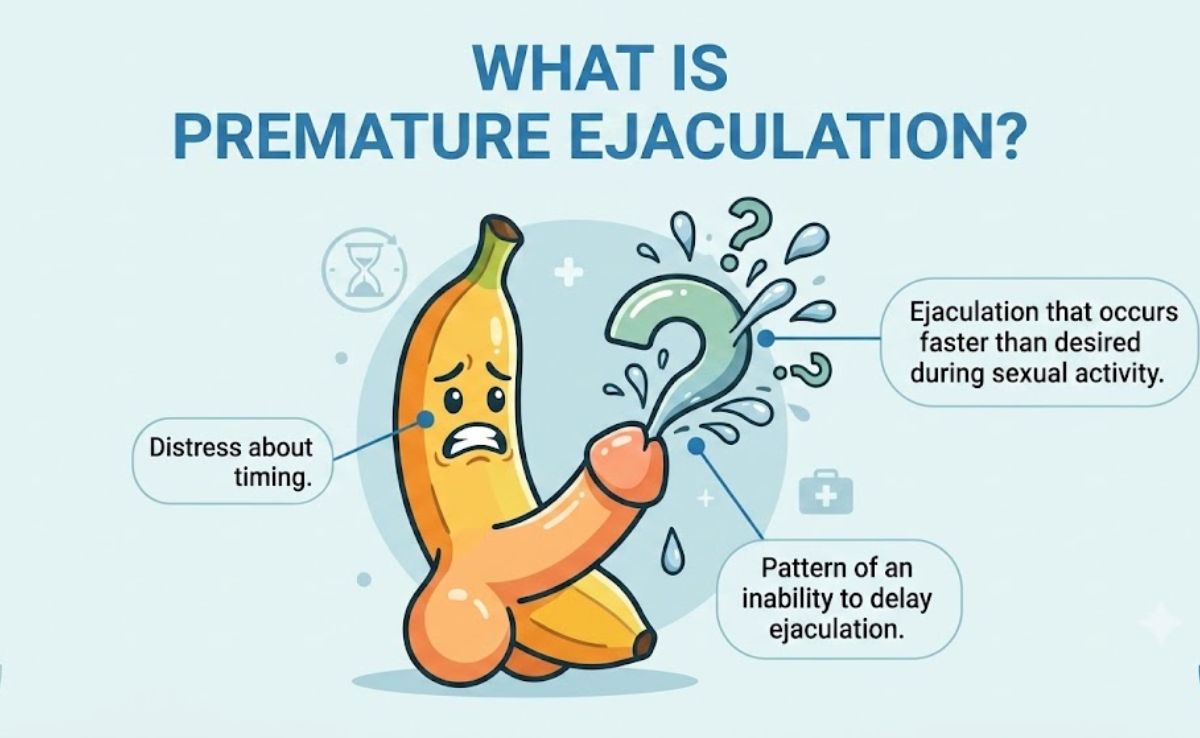
Premature ejaculation occurs when a man ejaculates sooner than he or his partner would prefer during sexual activity — typically within about one minute of penetration, though there’s no single rigid cutoff used across all clinical definitions. What matters clinically is less the exact timing and more the pattern: a consistent inability to delay ejaculation that causes distress, frustration, or avoidance of intimacy.
PE is generally classified into two types. Lifelong (primary) PE has been present since a man’s very first sexual experiences and remains fairly consistent over time. Acquired (secondary) PE develops later, after a period of normal ejaculatory function, and is often triggered by a specific stressor, health change, or relationship shift. This distinction matters for treatment — acquired PE in particular often points to an identifiable trigger worth investigating, rather than something to simply manage indefinitely.
It’s also worth being clear about what PE is not. Erectile dysfunction (ED) is the inability to achieve or maintain an erection firm enough for sex — a different mechanism entirely. The two conditions frequently coexist, but one doesn’t define the other, and treating them correctly depends on telling them apart.
PE Within the Bigger Picture: Ejaculatory Disorders
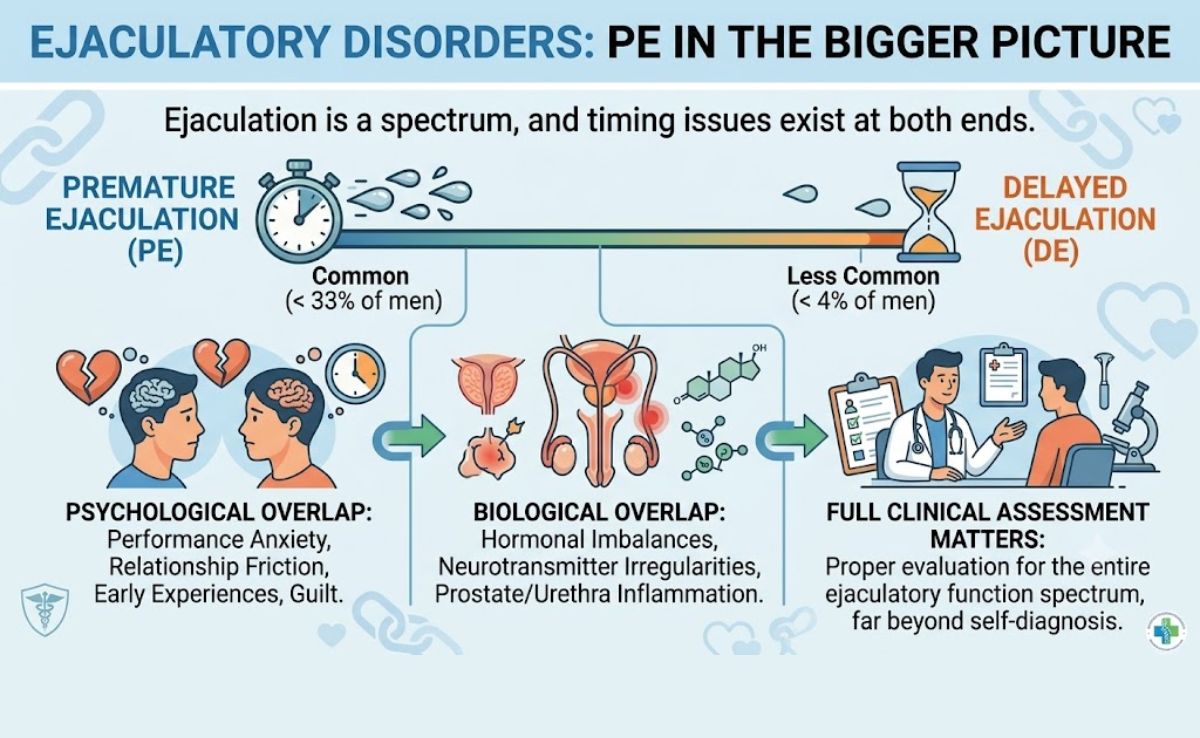
PE doesn’t exist in isolation — it’s one end of a spectrum that doctors refer to as ejaculatory disorders, which cover any consistent problem with the timing or occurrence of ejaculation. At the other end sits delayed ejaculation, where a man takes an unusually long time to climax or cannot do so at all. Population data suggests around a third of men experience premature ejaculation at some point, compared to roughly 4% who experience delayed ejaculation — making PE by far the more common of the two, but not the only ejaculatory pattern worth understanding.
Thinking about PE this way is useful because the contributing factors overlap significantly. Both ends of the spectrum can stem from psychological roots — early sexual experiences, anxiety, guilt, or relationship friction — or from biological ones, including hormonal imbalances, neurotransmitter irregularities, or inflammation and infection in the prostate or urethra. A man being assessed for PE is often being assessed, implicitly, for the full range of ejaculatory function — which is part of why a proper clinical evaluation matters more than self-diagnosis.
What Causes Premature Ejaculation?

PE is rarely caused by a single factor. The contributing causes generally fall into a few categories:
Psychological factors are among the most frequently cited triggers, particularly performance anxiety, generalised stress, depression, and relationship tension. For many men, the anxiety itself becomes self-reinforcing — worry about ejaculating quickly makes it more likely to happen, which increases worry the next time.
Hormonal and neurochemical factors play a meaningful role too. Lower serotonin activity is one of the most studied biological contributors to PE, since serotonin pathways help regulate the timing of ejaculation; low testosterone can also reduce ejaculatory control.
Penile hypersensitivity — simply having heightened nerve sensitivity in the penis — can mean a man reaches climax with less stimulation than typical, independent of any psychological factor.
Erectile dysfunction is a notable secondary cause: men who struggle to maintain an erection sometimes subconsciously rush toward ejaculation while they still can, developing PE as a learned response to an underlying ED problem.
Medical conditions including thyroid disorders, prostatitis, and certain neurological conditions can also contribute, which is one reason a medical evaluation — rather than guesswork — is the right starting point.
How PE Affects Life Beyond the Bedroom

The impact of PE rarely stays contained to the act itself. Men dealing with ongoing PE commonly describe a cascade of effects: anxiety about and avoidance of sexual intimacy, a decline in self-confidence, and a quiet sense of shame that’s hard to bring up even with a partner. Left unaddressed, this can create real distance in a relationship — not because of the PE itself, but because of what goes unsaid around it. There’s also a meaningful risk of secondary erectile dysfunction developing, as performance anxiety around ejaculation timing starts to interfere with arousal and erection more broadly.
This is exactly why early intervention tends to produce better outcomes than waiting it out. The longer PE goes unaddressed, the more likely it is to compound with anxiety, avoidance, or a secondary ED, turning what may have started as a fairly straightforward issue into a more layered one.
How Common Is Premature Ejaculation in Malaysia?
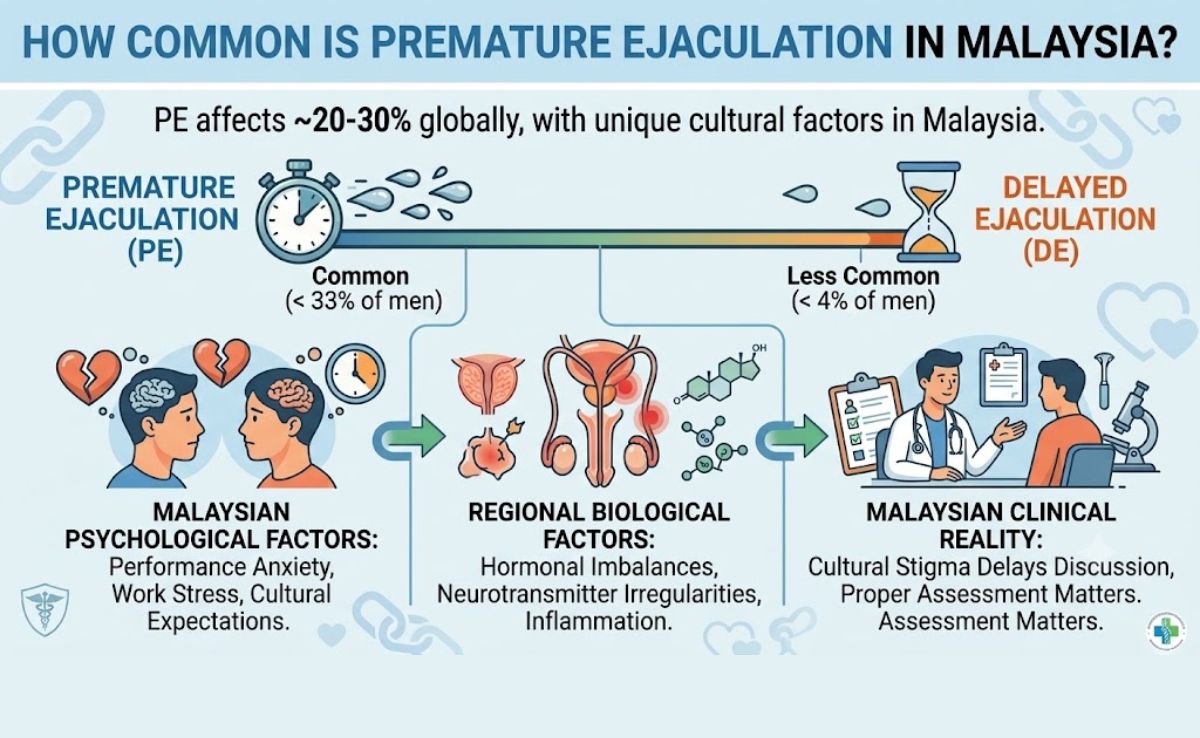
Globally, PE affects an estimated 20–30% of men across all age groups, making it the most prevalent male sexual dysfunction by a wide margin. In Malaysia and across Southeast Asia, cultural stigma around discussing sexual health openly likely means the real prevalence is even higher than what gets reported in clinics — many men simply never raise it. Anxiety tends to be the most frequently cited contributing factor regionally, often compounded by high-pressure work environments, relationship expectations, and limited public sexual health education.
Approaching Premature Ejaculation Treatment in Malaysia

Treatment for PE generally falls into two complementary tracks: conservative approaches and medical treatment, often used together rather than as alternatives. Conservative strategies include behavioural techniques and pelvic floor strengthening, which can build lasting ejaculatory control without medication. Medical treatment — oral medications, topical desensitising agents, and in select cases hormone therapy — tends to produce faster results and is particularly useful for men who haven’t responded to behavioural approaches alone, or who want a more immediate solution while longer-term strategies take effect.
For men whose PE developed secondary to erectile dysfunction, the most effective sequence is usually to address the ED first, since resolving the underlying erection problem often resolves the ejaculatory issue alongside it. Our Premature Ejaculation Treatment page outlines the specific treatments available — including oral medications, EM-Kegel pelvic floor therapy, shockwave therapy, topical agents, and testosterone replacement — along with how each is matched to different underlying causes.
When to See a Doctor

PE is worth raising with a doctor if it’s happening consistently rather than occasionally, if it’s affecting your confidence or your relationship, if you’re also noticing erection difficulties, or if you suspect an underlying hormonal or medical cause. There’s no version of this conversation that should feel embarrassing in a clinical setting — it’s one of the most common reasons men book a consultation, and it’s entirely treatable in the vast majority of cases.